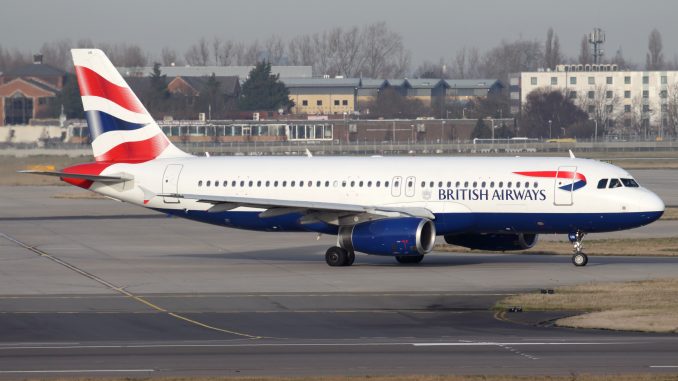
A British Airways Airbus A320 encountered multiple stall warnings on approach to London Heathrow on July 6, after an Air Data Reference (ADR) failure.
Preliminary information published by France’s Bureau of Enquiry and Analysis for Civil Aviation Safety (BEA), based on notification from the UK Air Accidents Investigation Branch, said the ADR failure triggered an initial stall warning during approach.
The flight crew of the A320-232, G-EUUN (c/n 1910), then continued the approach with the aircraft in Alternate Law and declared a PAN-PAN.
The BEA said a subsequent stall warning occurred at 3,000ft, to which the crew responded with a “possible aggressive recovery”, after which the crew upgraded the emergency call to a MAYDAY.
The aircraft – which had been returning from Dusseldorf – landed without further incident and none of the passengers or crew on board were injured.
G-EUUN – which is one of British Airways’ oldest A320s – was delivered to the carrier on January 31, 2003 and is configured to seat a maximum of 180 passengers.
Following the incident, the Airbus remained on the ground for the remainder of July 6 and 7, and returned to service on July 8.
What are ADR and Alternate Law?
ADR, or Air Data Reference, calculates information including airspeed, altitude, vertical speed and angle of attack using data received from the aircraft’s air-data sensors.
Alternate Law is a degraded flight-control mode in which some of the A320’s normal flight-envelope protections and automation may be unavailable. Airbus says the rejection or deselection of multiple ADR sources can result in the loss of the autopilot, flight directors and autothrust, together with a reversion to manual Alternate Law.