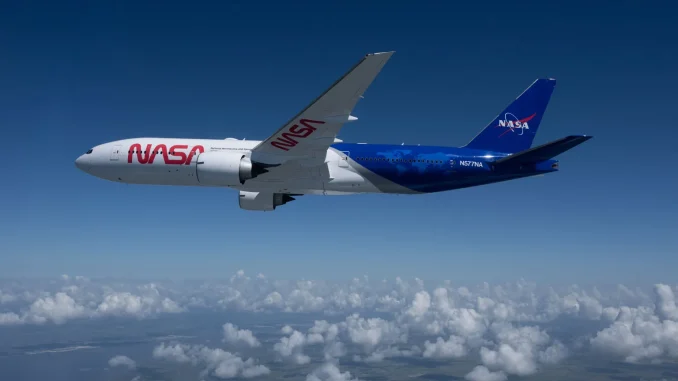
NASA’s newest airborne research aircraft is being readied for its first scientific mission, scheduled for January 2027.
The former Japan Airlines aircraft, N577NA (c/n 32892), was built in 2003. The US space agency acquired it in 2022 to replace its veteran Douglas DC-8, which retired two years later after decades of scientific work.
NASA has since converted the 777 into a flying laboratory, with L3Harris Technologies and Yulista Solutions in Waco, Texas, carrying out much of the work. Modifications include larger observation windows and openings in the lower fuselage to accommodate specialist instruments.
Its first mission will take it to polar regions. Here, researchers will collect data on atmospheric conditions and winter weather. The measurements will help scientists fill gaps in satellite observations and improve their understanding of weather patterns.
Compared with the DC-8, the 777 provides substantially more room for scientists and their equipment. It can accommodate 50 to 100 researchers, carry around 75,000lb (34 tonnes) of scientific instruments, and fly for up to 18 hours. Its maximum published range is 9,000 nautical miles.
NASA’s 777 programme manager, Kirsten Boogaard, expects about 100 instrument team members to participate in the first campaign, compared with about 40 on the DC-8.
Further work is already being lined up. A 2028 mission will investigate urban air pollution, while other proposed projects include atmospheric studies and satellite calibration. NASA has received requests to use the aircraft through to 2033.