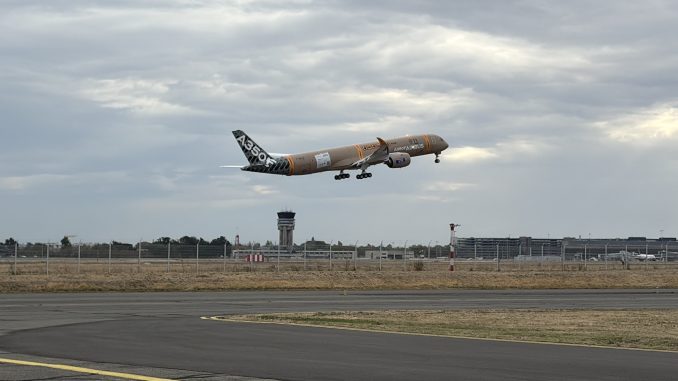
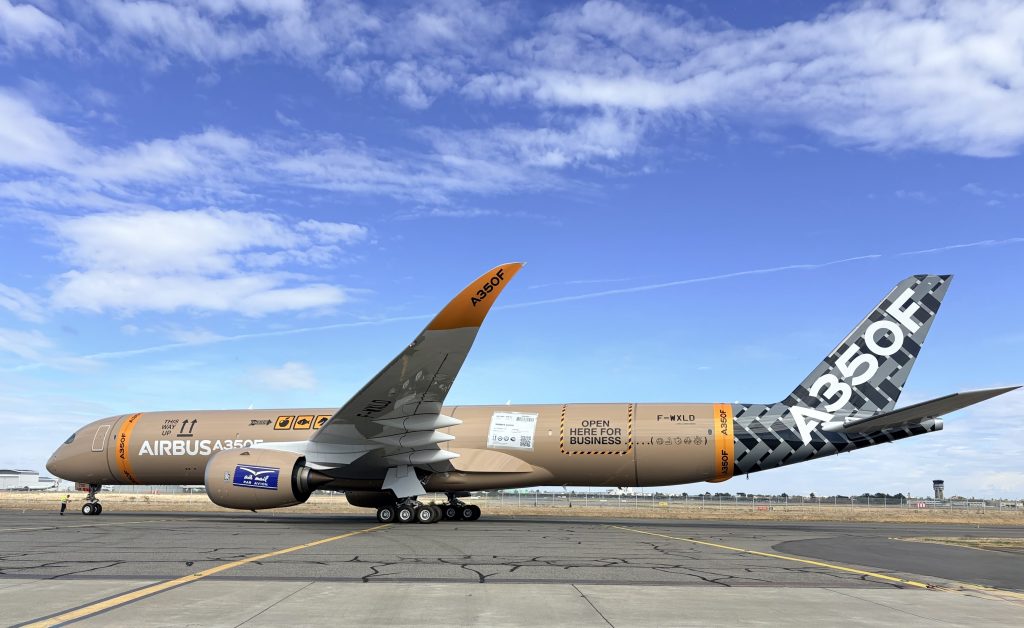
Tuesday September 29 marked a historic moment for Airbus, after the prototype A350-1041F, F-WXLD (c/n 700), took to the skies from the plane makers Toulouse facility for the first time.
After months of ground testing, which has included cargo door actuation system, oxygen tests, air distribution, smoke detection, and CargoZERO – the cargo loading system test bench, as well as engine runs and taxi tests on September 18, plus rejected take-offs on September 24 and 25, it was time for the manufacturer’s game-changing new aircraft to take flight.
Time for take off
The maiden sortie took off from Runway 14R at Toulouse/Blagnac on time at 1030 local time, rotating right in front of the assembled crowd.
On the flight deck was captain and test pilot Bernardo Saez-Benito, accompanied by first officer and experimental test pilot Sylvain Guiraud, together with test flight engineer Ludovic Girard. In addition, lead flight test engineers Laurent Bussiere and Jaime Angoloti were onboard.
Jean Philippe Cottet, Airbus head of flight tests said that the flight crew team had been working together closely over the past six months, bringing the most valuable part of the previous A350 Family test flights to reduce the overall time of the flight test programme.
When asked about the main challenges with developing a dedicated freighter from the existing A350 passenger family, Julien Puyou, head of widebody programme, told Airliner World that the cargo door had been the biggest issue.
“We wanted to make it as big as possible,” Puyou said. “And we really went to the limit of technology.”
Indeed, Airbus says the opening is 17% wider than that of its competitor and is large enough to accommodate all current large commercial engines without the more complex loading manoeuvres required by some existing freighters.
Later, we spoke to Crawford Hamilton, head of freighter marketing, about the feedback Airbus had received so far from its customers. “I think they’ve been impressed at the depth that we have gone into in every detail,” Hamilton explained. A lot of the things we have included in the aircraft, such as the segregated fresh air crew area, has come from our customers. There’s been a lot of back and forth to make sure that we’re approaching things in the right way.
“But the overall feedback so far has been positive. They like it. They like its size. They like the platform. They like its technology.”
A special delivery
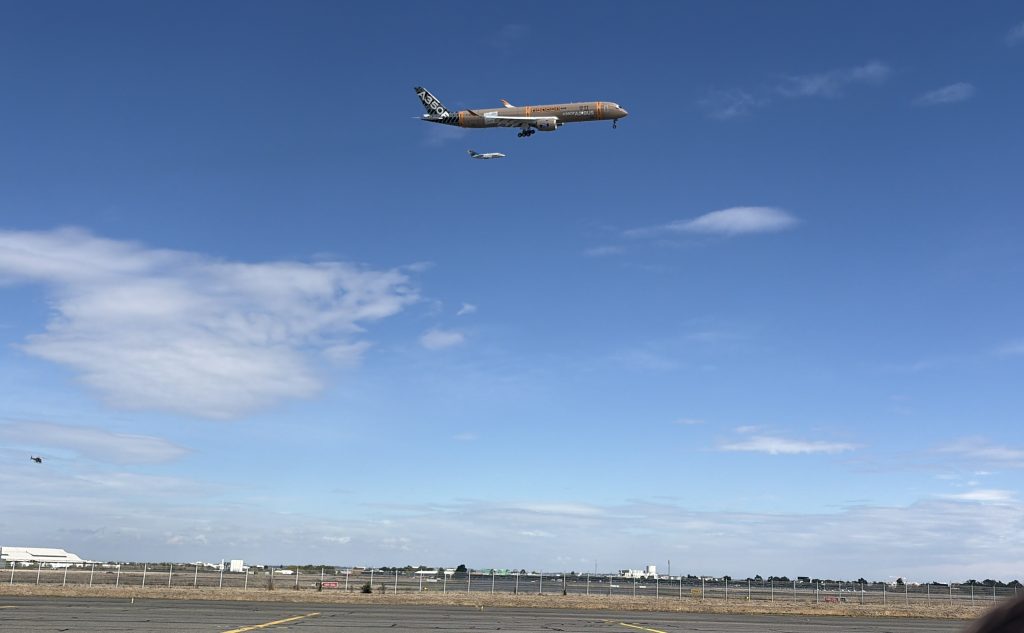
At around 1435, the aircraft made a low flyover of the airport, giving a wing salute as it flew over the delivery centre.
Five minutes later the Lima Delta was back, touching down on runway 14R before taxiing round to the delivery centre.
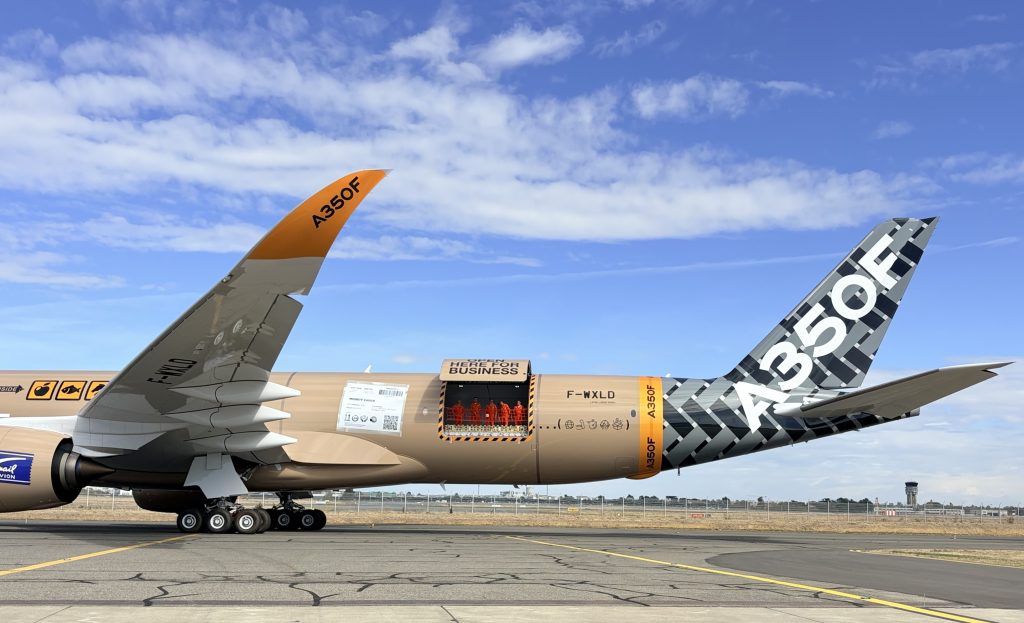
After a short pause, the freighter’s main selling point – the largest cargo door on the market – slowly opened to reveal the flight crew members, to a rapturous applause from the crowd.
It was then time for the team to take to the stage, with the backdrop being the star of the show. Introduced by Lars Wagner, CEO of the Commercial Aircraft business, the team said that the latest member of the Airbus family had performed well and that the maiden flight had gone exactly to plan.
Wagner later commented that they would refer to this historic day as “Day F. Freighter Day.”
Today’s sortie marked the start of an approximately nine-month certification campaign involving two development aircraft. F-WXLD is expected to undertake around 300 flight-test hours, concentrating primarily on aerodynamic performance and handling, while sistership, F-WCGO (c/n 701) is set toconduct a further 110 hours focused heavily on environmental systems, smoke testing and operational maturity
Background
Airbus launched the A350F programme in 2021 as a new-generation replacement for ageing large freighters and as a direct challenge to Boeing’s long-standing dominance of the heavy air cargo market. Based on the A350 Family, the aircraft draws heavily on the larger A350-1000, including its wing, six-wheel main landing gear and Rolls-Royce Trent XWB-97 powerplants, while incorporating a purpose-designed fuselage and cargo handling system. Final assembly of the first aircraft began in Toulouse in 2025.
The A350F has a maximum payload capability of up to 111 tonnes and a range of up to 4,700nm (8,700km). At 70.8m long, it is shorter than the passenger A350-1000 and has been optimised around standard industry pallets and containers. The main deck accommodates 30 pallet positions.
More than 70% of the A350F is constructed from advanced materials, including carbon-fibre composites, helping reduce structural weight. Airbus says the jet will consume around 20% less fuel and produce around 20% fewer CO₂ emissions than previous-generation freighters offering a similar payload and range, while considerably larger savings are claimed against older types such as the Boeing 747-400F. It has also been designed to comply with the latest ICAO CO₂ emissions standard applicable to newly produced aircraft.
A major part of Airbus’s sales pitch is commonality with passenger A350s. The manufacturer quotes 100% commonality in engine spares and tooling, 99% in airframe tooling and 98% in airframe spares, potentially reducing additional training, maintenance and inventory requirements for existing A350 operators. The freighter also retains the A350’s modern cockpit and fly-by-wire architecture.
The programme has attracted orders from a growing number of operators. As of the maiden flight Airbus holds 115 firm orders from 14 disclosed customers including Atlas Air and Singapore Airlines, plus one undisclosed customer
Certification work will now continue ahead of planned entry into commercial service in 2027.
There will be a full report on the momentous occasion in a forthcoming issue of Airliner World.