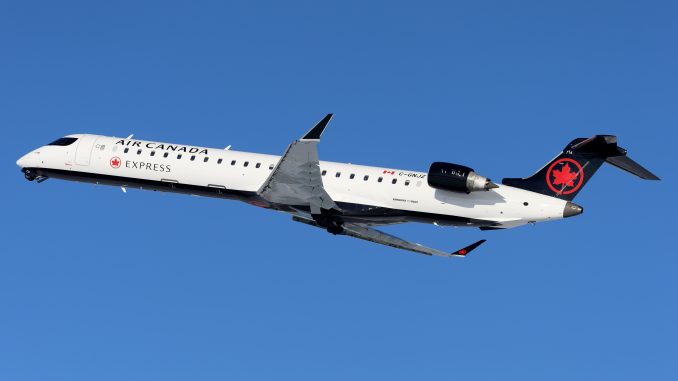
The fire truck which was struck by a landing Air Canada Express Bombardier CRJ at New York/LaGuardia failed to heed multiple stop calls made by air traffic control (ATC), a preliminary report by the US National Transportation Safety Board (NTSB) has revealed.
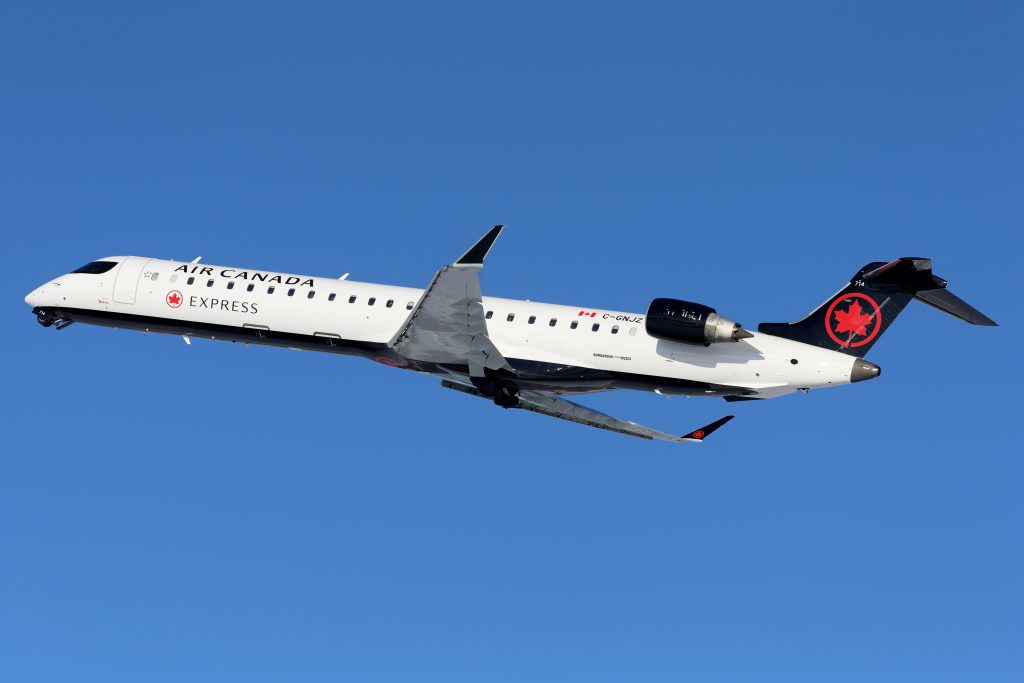
The March 22 crash of Air Canada flight 8646 – operated by a Jazz Aviation CRJ-900, C-GNJZ (c/n 15052) – killed the two pilots and seriously injured six others.
Preliminary review of aircraft and fire truck tracking data, ATC and aircraft cockpit voice recorder (CVR) audio recordings, flight data recorder (FDR) information, and CCTV video, revealed that prior to the accident, six Aircraft Rescue and Fire Fighting (ARFF) vehicles – comprising four ARFF trucks, a tool truck and an airstair truck, along with a Port Authority police vehicle, were responding to an emergency near Terminal B.
According to investigators, flight 8646 was cleared to land by the tower on runway 4 at 1135hrs local time, when the aircraft was on a five-mile final at an altitude of about 1,900ft. Around 20 seconds later, the incident fire truck – designated Rescue 35 with a callsign ‘Truck 1’ – left the fire station, along with the other vehicles.
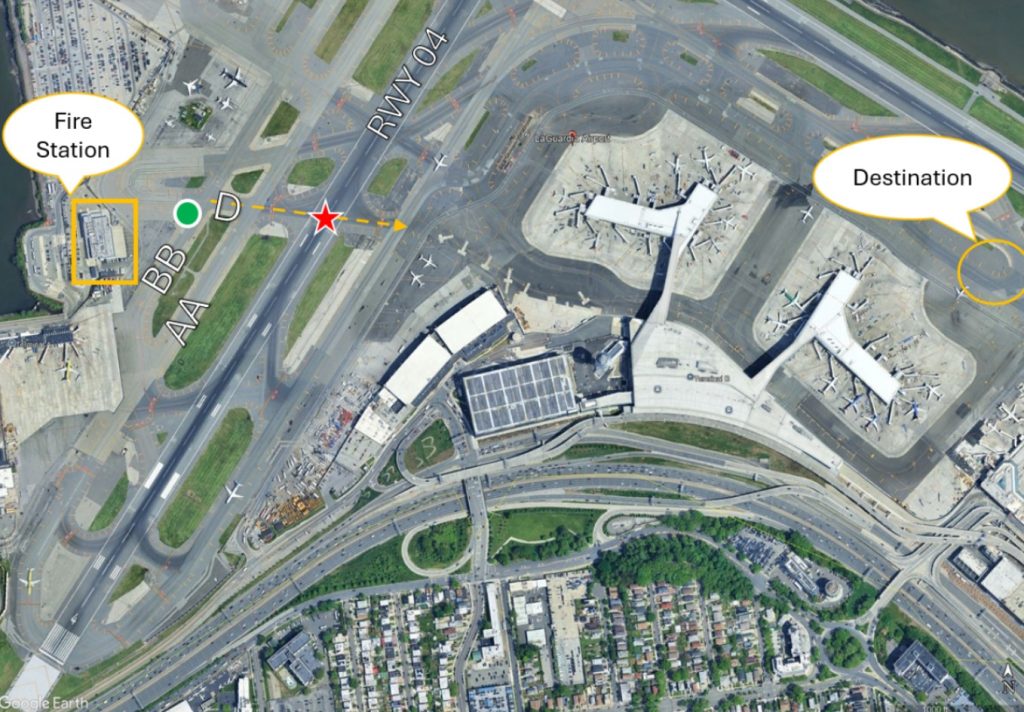
The vehicles travelled along taxiway D before gathering near the intersection of taxiways BB and D, around 500ft from the threshold of runway 4. The initial plan was for the tool truck (callsign ‘Truck 7’) to be the lead vehicle so the crew attempted to contact ATC for permission to cross the runway. However, Truck 7 was unable to make contact with the tower and instead asked Truck 1 to call ATC instead.
The controller responded asking which vehicle needed to cross the runway, meanwhile, Truck 1 moved to the front of the waiting convoy. At this point, the aircraft was about 1.5nm from taxiway D and at an altitude of 400ft.
At 1136hrs, the runway entrance lights (RELs) – which are normally off, but are switched on when an aircraft is approaching the intersection – were illuminated for the intersection of runway 4 and taxiway D. At this time, flight 8646 was about 1.2nm from taxiway D at 287ft altitude and Truck 1 was stopped on D about 460ft from the edge of the runway.
Truck 1 then requested and received clearance for the convoy of vehicles to cross runway 4 at taxiway D, with the crew reading back the clearance and then beginning to move towards the runway.
However, as Truck 1 crossed taxiway AA about 300ft from the threshold, the tower controller ordered it to stop. At this time the truck’s speed continued to increase and flight 8646 was about 2,550ft from taxiway D at 30ft altitude and 133kts ground speed.
When the aircraft touched down, Truck 1 had crossed the hold short line at a speed of 24mph. The tower controller again instructed Truck 1 to stop when it was just over 100ft from entering runway 4 and travelling at 29mph.
The RELs extinguished almost immediately afterwards – in line with their normal operation which sees them go out automatically, approximately two to three seconds before an aircraft passes the intersection.
Roughly two seconds before the collision, the aircraft’s nose landing gear touched down while the aircraft was about 400ft from taxiway D and at a groundspeed of 106kts. Truck 1 was travelling at 30mph and just entering runway 4.
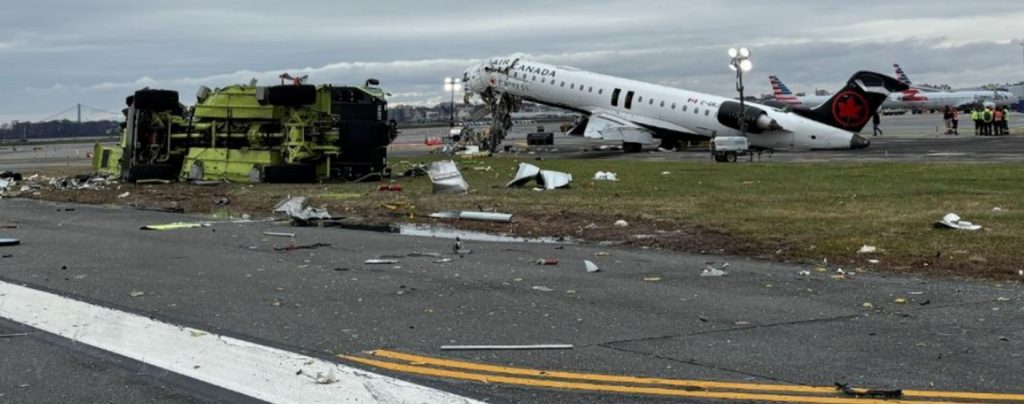
According to the report, Truck 1 turned left just prior to the collision. The aircraft’s rudder deflected about 6° to the left just before the end of the FDR recording. The collision occurred at the intersection of taxiway D and runway 4 with the aircraft travelling at approximately 90kts.
The impact destroyed the cockpit, fatally injuring the pilots and seriously injuring one cabin crew member. Out of the 72 passengers, three were seriously injured while 33 received minor injuries. Truck 1 was heavily damaged, but both crew members survived with serious injuries.
Ground radar
In addition to being equipped with a runway status light system comprising the RELs at most taxiway/runway intersections, LaGuardia was also equipped with Airport Surface Detection Equipment, Model X (ASDE-X), which was a surface surveillance system used by ATC to track surface movement of aircraft and ground vehicles.
The technology uses multiple inputs – including ADS-B, Mode S transponders, terminal automation systems and multilateration sensors – to provide a radar display in the tower for controllers to see.
A review of the ADSE-X system by the FAA determined that it did not generate an aural warning or visual alert during the incident. Multiple ground vehicles, none of which were equipped with transponders, were intermittently detected as radar targets while holding on taxiway D at taxiway BB. However, the NTSB said that “due to their close (and varying) proximity to each other, and the intermittent merging and unmerging of radar targets, the ASDE-X system was unable to establish high-confidence tracks.”
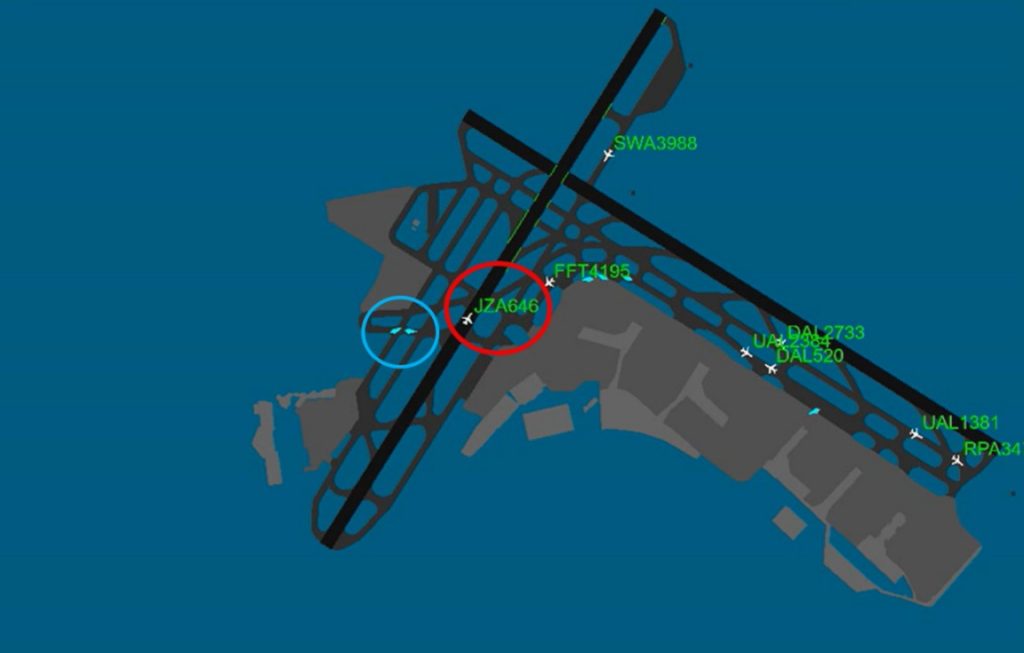
At the time of the accident, the system was only displaying two radar targets, rather than all seven of the response vehicles as distinct targets at their respective locations.
The NTSB said: “Without transponder-equipped vehicles, the ASDE-X system could not uniquely identify each of the seven responding vehicles or reliably determine their positions, or tracks. As a result, the system was unable to correlate the track of the airplane with the track of Truck 1 (or any of the other vehicles in the group) and did not predict a potential conflict with the landing airplane.”
The investigation continues.