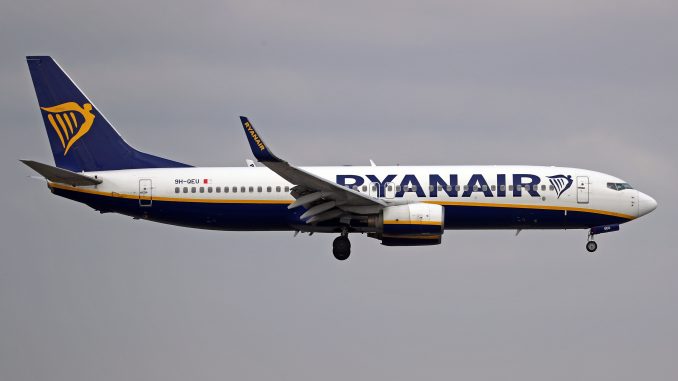
A Malta Air Boeing 737 suffered a fan blade separation that sent engine debris into the fuselage, leading to a cabin depressurisation during which a passenger became “partially lodged in a damaged cabin window”.
A preliminary report by the US National Transportation Safety Board (NTSB) has revealed new details about the July 10 incident, including evidence of fan blade fatigue and bird remains in the engine.
The Boeing 737-8AS, 9H-QEU (c/n 36569), was operating Ryanair flight 1879 – a scheduled service between Thessaloniki, Greece and Memmingen, Germany – with 149 passengers, four cabin crew and two pilots on board.
Chain of events
The flight crew told the investigation that while climbing through an altitude of 16,000ft, near Polykastro, Greece, they received a No.2 engine HIGH VIBRATION indication.
The pilots reduced the engine power and initiated the Engine High Vibration non-normal checklist. Short after, the engine vibration indication reduced, and the crew continued the climb on autopilot.
However, engine vibrations subsequently increased significantly, with the crew telling the investigation that they heard a “loud bang”. The autopilot then disengaged.
“While assessing the engine condition, the cabin altitude warning sounded,” the NTSB report said. “The flight crew donned their oxygen masks, declared an emergency, and began an immediate descent.”
In the cabin, the crew were preparing for service when they reported hearing and feeling a “loud continuous vibration and seeing a small amount of fog/smoke before the oxygen masks dropped.”
Passengers donned their oxygen masks with some standing up to ask for help.
“The FA [flight attendant] noticed that the passenger in seat 11F was partially lodged in a damaged cabin window, and that the entire window was missing,” the report said. “Other passengers were assisting and managed to pull the injured passenger back into the cabin.”
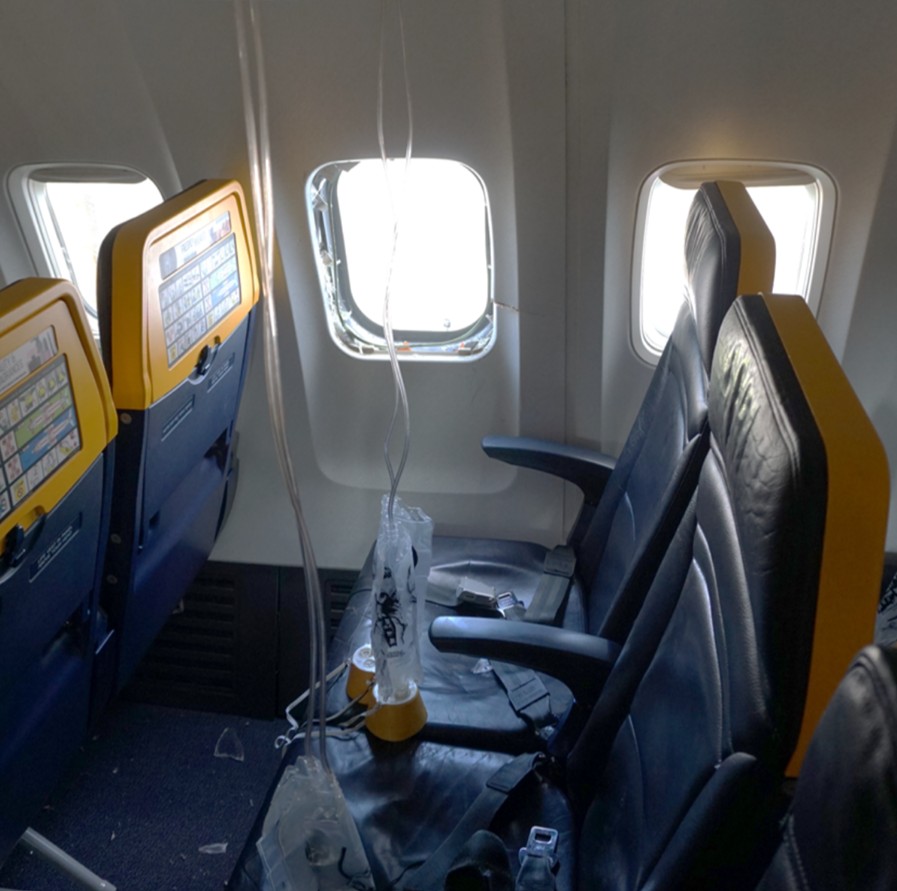
The injured passenger was moved to the row in front and was attended to by a passenger, who was a doctor, throughout the remainder of the flight.
The cabin crew communicated with the flight deck, confirmed the pilots were okay, and were informed of the engine failure, decompression and the intent to return to Thessaloniki with an estimated time enroute of 20 minutes.
After descending below 10,000ft, the flight crew “secured the No.2 engine” and an uneventful landing followed. The aircraft remained on the runway for inspection and then proceeded to the gate.
Engine debris punctures fuselage
The NTSB investigators found that the No.2 engine – a CFM International CFM56-7B26 – experienced a fan blade separation that resulted in engine fragments striking the fuselage and right horizontal stabiliser.
The pressurised section of the fuselage was punctured in two places: through a passenger window at row 11 as well as through the lower fuselage behind the right wing. Investigators also found dents and gouges on the fuselage, wing-to-body fairing and right horizontal stabiliser (upper skin and leading edge).
Examination of the engine and nacelle revealed that one fan blade (No.10) had fractured and separated close to its base, while the tips of two other blades (Nos. 16 and 21) also broke away.
The remaining blades stayed attached but showed varying degrees of impact damage. Three loose fan blade fragments were recovered from the engine.
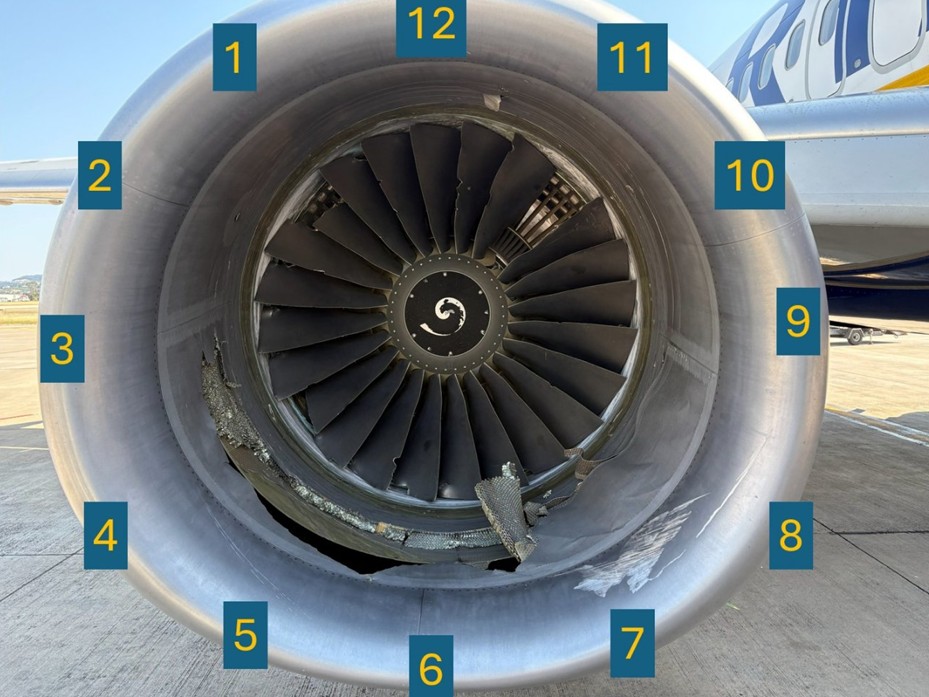
According to the NTSB, examination of the No.10 fan blade found evidence of fatigue on 37% of the fracture surface. Microscopic examination found features consistent with high-amplitude fatigue originating in the blade dovetail near its trailing edge.
However, the preliminary report does not determine what caused the fatigue loading or whether it was responsible for initiating the eventual blade separation. The NTSB investigation remains ongoing.
Maintenance records showed the fan blades had undergone ultrasonic inspections as recently as May 24, 2026 – 253 flight cycles before the accident flight – “with no findings”.
The report said a visual examination of the core was performed by investigators and there was “no evidence of radial uncontainment though the engine cases, or any undercowl fire”.
However, the engine inlet cowl, which is forward of the fan case, exhibited evidence of punctures. The inlet and fan cowling remained attached to the engine.
Bird remains recovered
The NTSB also detailed that bird remains, including feathers, were recovered from the “forward face of integrated drive generator (IDG) oil cooler, one of the thrust reverser blocker door drag links, and the lower (6 o’clock position) of the engine fan case near the thrust reverser split flange”.
The remains, along with the samples from the fan blades, were transported to the Smithsonian Institution Feather Identification Lab in Washington, DC, for examination.
Four suspected bird strikes to the accident aircraft’s No. 2 engine were reported by flight crews in the 12 months preceding the accident. No damage was found in the subsequent maintenance actions. Bird remains were reportedly found in two of the cases.
The report said the engine had not been fitted with reinforcements for the fan and inlet cowl hardware and exhaust nozzle that were recommended by multiple Airworthiness Directives (AD) issued in 2025. Operators of the Boeing 737NG have until July 2028 to comply with the ADs.
The investigation remains ongoing.