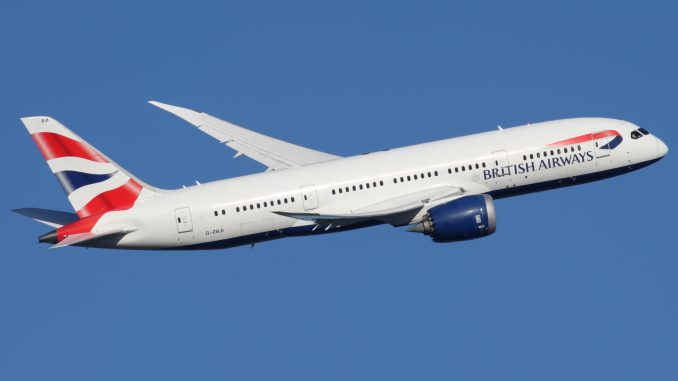
British Airways is rolling out free Starlink Wi-Fi across its fleet, promising broadband-like internet at 38,000ft. Airliner World Editor Thomas Haynes tested the new system on a long-haul flight – and recorded download speeds approaching 400Mbps.
“We’re delighted to say that the Wi-Fi today is powered by Starlink, the fastest Wi-Fi in the skies.”
It is the sort of onboard announcement that would once have been greeted with a degree of scepticism.
Inflight Wi-Fi has traditionally meant login portals, paid packages and connections that were often good enough for little more than messaging or basic browsing. If they worked at all.
British Airways’ new Starlink Wi-Fi is in a completely different league.
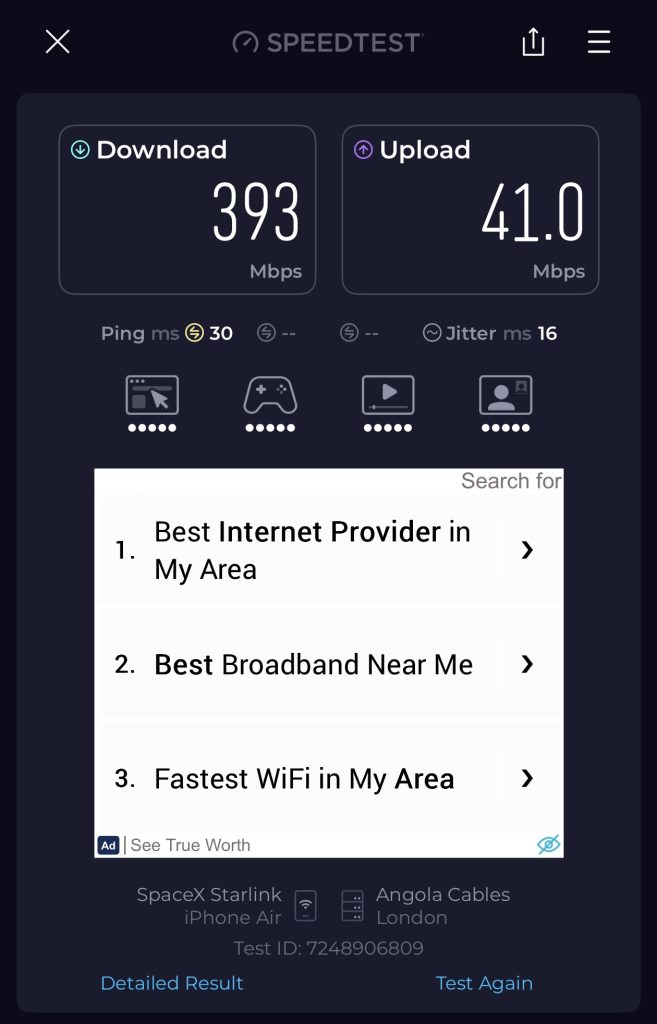
Within around ten minutes of departure, I recorded download speeds approaching 400Mbps – faster than many home broadband connections.
And perhaps just as impressive as the speed was how little effort it took to get online.
How do you connect to British Airways Starlink Wi-Fi?
Connecting to BA’s Starlink Wi-Fi could hardly be simpler.
Open the Wi-Fi settings on your phone, tablet or laptop and select BA Starlink. A window appears, you press to connect, and you are online.
That is it.
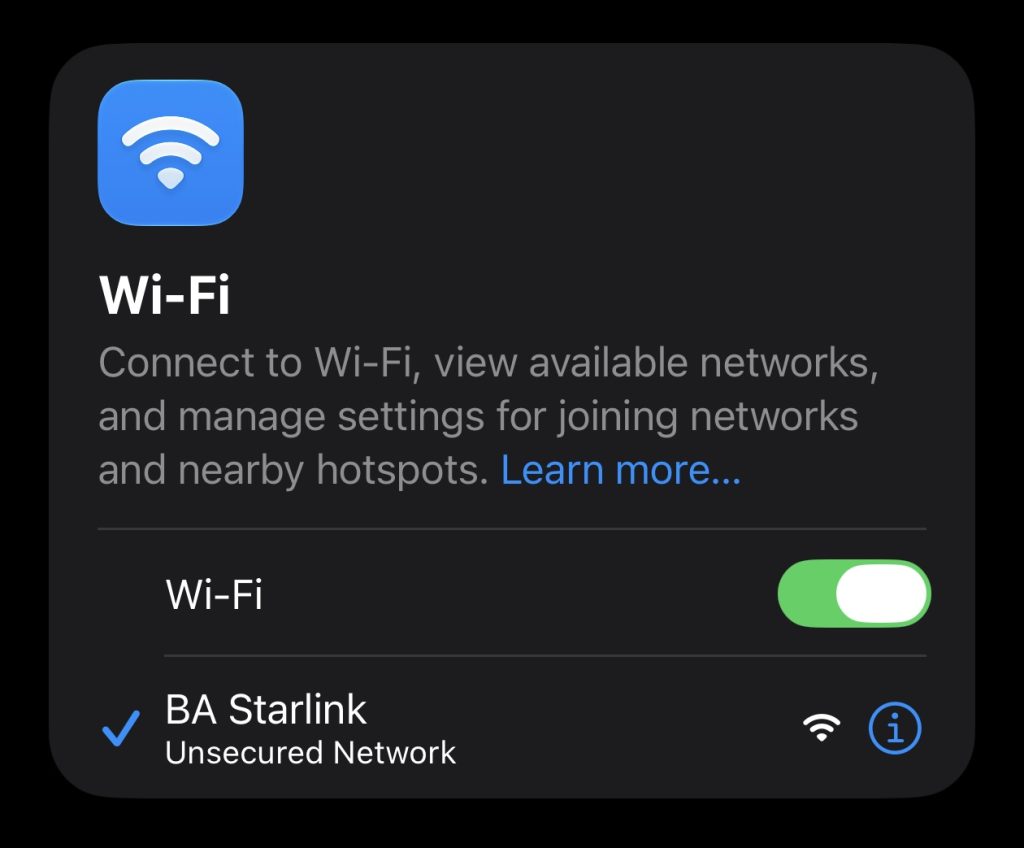
There was no British Airways Club login, no seat number, no passenger details and no payment information required.
It is probably the simplest inflight Wi-Fi connection process I have encountered.
Multiple devices can also be connected, meaning there is no need to choose between having your phone, tablet or laptop online.
How fast is British Airways Starlink Wi-Fi?
The first speed test, conducted shortly after take-off, produced a download speed of around 60Mbps.
Even that would have been impressive for an aircraft internet connection.
Around ten minutes later, however, another test returned almost 400Mbps.
For context, previous generations of inflight Wi-Fi could sometimes struggle with relatively straightforward webpages or larger email attachments.
Here, websites loaded virtually instantly and the connection behaved much more like a good terrestrial broadband service.
Speeds also remained remarkably stable as the flight continued.
British Airways says Starlink is capable of delivering more than 500Mbps to an aircraft, putting the performance I experienced well within the sort of speeds the airline says the system can provide.
Is British Airways Starlink Wi-Fi free?
Yes – and this is arguably one of the most important aspects of the service.
British Airways is offering its Starlink Wi-Fi free of charge in every cabin.
There is no data allowance, while passengers can connect multiple devices.
That fundamentally changes the way you use Wi-Fi onboard.
With traditional inflight connectivity, there has always been a calculation involved: do I really need to get online badly enough to justify paying for it?
With Starlink, you simply connect.
Ironically, before departure I had been frantically downloading programmes from BBC iPlayer to make sure I had enough entertainment for the flight.
Once onboard, that suddenly seemed rather unnecessary.
A connection running at hundreds of megabits per second makes streaming video feel far less ambitious than it once did at altitude.
When will British Airways have Starlink across its fleet?
British Airways has begun a fleet-wide rollout of Starlink, with the technology being introduced progressively across both its long- and short-haul aircraft.
The airline says every aircraft in its fleet is expected to offer Starlink within two years.
Until that programme is complete, whether a particular flight offers the new service will depend on the aircraft operating it.
At the moment the rollout is limited to a handful of Boeing 787-8s and Airbus A350-1000s.
Does British Airways Starlink work everywhere?
Not quite.
Starlink coverage is extensive, including across many oceanic and remote areas, but there remain countries where service is unavailable because of regulatory restrictions.
British Airways currently lists India, China and Russia among the territories where Starlink connectivity is not available.
That means passengers on some longer routes may still encounter periods without connectivity despite having a Starlink-equipped aircraft.
We were advised on today’s flight to Mumbai that once we entered Indian airspace, the connection could become patchy. Reading official guidance, it says that Starlink is not available in India due to regulatory restrictions.
What makes Starlink different from traditional inflight Wi-Fi?
Starlink uses a constellation of satellites in low-Earth orbit, or LEO.
Because these satellites operate much closer to Earth than traditional geostationary communications satellites, the system can provide lower latency and significantly greater capacity.
For passengers, however, the technology itself is arguably less important than the end result.
The key difference is that the internet suddenly feels normal.
I have previously used newer-generation inflight connectivity aboard an American Airlines Boeing 787, but the broader direction of travel is increasingly clear.
The days when aircraft Wi-Fi was an expensive and heavily compromised substitute for internet access on the ground appear to be disappearing.
British Airways and Virgin Atlantic race to roll out Starlink
British Airways is not alone in pursuing Starlink.
Virgin Atlantic is also rolling out the service across its fleet and has accelerated its installation programme, with fleet-wide coverage planned for 2027.
That creates an interesting contest between two of the UK’s major long-haul airlines as fast, complimentary connectivity becomes an increasingly prominent part of the passenger experience.
For travellers, the competition can only make reliable high-speed internet at altitude more commonplace.
Would I pay for British Airways Starlink?
This may be the most telling question of all.
Fortunately, British Airways is offering Starlink free of charge – but having used it, would I actually pay for the service?
Probably, yes.
I could rarely say the same about previous generations of inflight Wi-Fi.
Unless I genuinely needed to work, paying for an unreliable and often painfully slow internet connection had limited appeal.
Starlink is different.
When the connection is running at hundreds of megabits per second and feels little different from the internet you use at home, paying for access becomes far easier to justify.
Thankfully, BA passengers do not have to.
Verdict: Is British Airways Starlink worth the hype?
After experiencing download speeds approaching 400Mbps at altitude, it is difficult to see inflight connectivity in quite the same way.
The headline speed is impressive, but the simplicity may prove just as important.
There is no complicated login process. No payment. No restrictive data allowance. Multiple devices can be connected. And, during my test at least, the connection was remarkably stable.
There will still be coverage gaps, and performance will inevitably vary depending on factors including the route and network demand.
But compared with traditional inflight Wi-Fi, this feels like a generational leap.
And that really is a game changer.