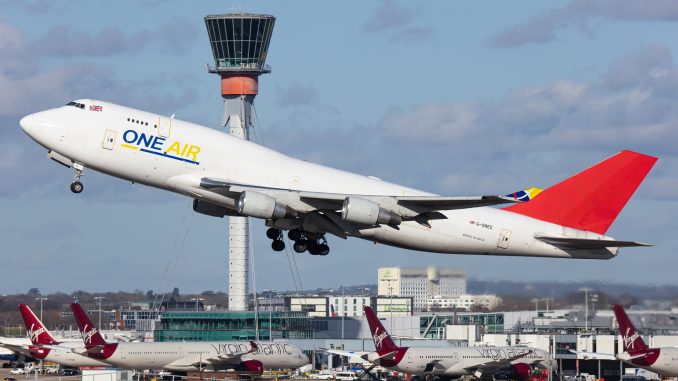
A One Air Boeing 747-433BDSF suffered multiple electrical failures shortly after departing London/Heathrow after water entered its Main Equipment Centre (MEC), according to the UK Air Accidents Investigation Branch (AAIB).
The incident involving G-ONEE (c/n 24998) occurred on February 8, 2024, while the freighter was operating to Hong Kong International Airport. The AAIB has issued four safety recommendations following its investigation.
The aircraft had undergone overnight maintenance before the flight, during which its forward L1 door remained open. An easterly wind was blowing rain towards the doorway, something noted by the three pilots operating the flight.
Electrical problems began during the take-off roll from Heathrow’s Runway 09R, with multiple Engine Indicating and Crew Alerting System (EICAS) messages appearing during the initial climb.
The autothrottle became unavailable, while the LNAV and VNAV autopilot flight director system modes also became inoperative. The crew continued the departure using basic lateral and vertical modes before beginning the Quick Reference Handbook (QRH) procedure for the loss of AC Bus 4.
Four minutes later, AC Bus 1 also lost power, causing the cockpit voice recorder to stop operating for the remainder of the flight.
Although the crew temporarily restored AC Bus 4 three times, it eventually failed completely. As the QRH does not include a procedure covering multiple AC bus failures, the pilots combined information from the separate AC Bus 1 and AC Bus 4 checklists.
A PAN was declared and the aircraft levelled at 25,000ft while the crew considered its options.
With AC buses 1 and 4 unavailable, the pitot probe heaters on both sides of the aircraft were also inoperative, creating a risk of unreliable airspeed indications in icing conditions.
The crew requested radar vectors to avoid icing where possible and asked air traffic control which airports within approximately 90 minutes offered the best prospects for visual meteorological conditions.
Amsterdam/Schiphol was suggested by another aircraft on frequency, with ATC reporting clear conditions and light winds. Newcastle, Glasgow and Edinburgh were also offered, but the crew elected to divert to Schiphol.
As the 747 descended, the cabin altitude began climbing through 8,600ft, prompting the pilot flying to begin a descent to avoid reaching the point at which oxygen masks would be required.
The crew also prepared for the possibility of unreliable airspeed indications while descending through cloud.
Passing through approximately 12,000ft in icing conditions, all three airspeed indicators began showing decreasing speeds and the aircraft’s nose dropped. The 747 reached a nose-down attitude of 7.6° and a descent rate of 6,240ft per minute before an IAS disagree warning was generated.
As the aircraft passed through 10,000ft and exited the icing conditions, its pitot tubes cleared and indicated airspeed increased sharply. The autopilot responded by increasing pitch, while the pilot flying reduced thrust, although an overspeed warning was subsequently generated.
The aircraft later emerged from cloud and continued towards Schiphol.
During configuration for the approach to Runway 06, a FLAPS DRIVE caution was generated, requiring another checklist and a higher landing speed. The aircraft subsequently landed without further incident and taxied to a remote stand.
Investigators found that water had entered the MEC and contaminated Generator Control Units 1 and 4.
Although the main cargo deck, including the floor above the MEC, is designed as a “wet area”, required water curtains over the E1/E2 equipment rack had not been installed.
Further inspection identified deteriorated moisture barrier and polyurethane tape above the racks, while compromised sealant around a drip shield above GCU 4 could also have allowed water to reach the unit.
An AAIB inspection in June 2024 additionally found missing sealant at the forward right-hand corner of the L1 door mat, providing another possible route for water to travel towards the equipment racks.
The investigation highlighted a similar electrical failure involving Qantas Boeing 747-438 VH-OJM in January 2008. Boeing had previously issued service bulletins recommending the installation of moisture barriers, although these had not been mandated by a US Federal Aviation Administration Airworthiness Directive.
The AAIB has now issued four safety recommendations to Boeing and Israel Aerospace Industries (IAI), including calls for repetitive inspections of floor seals, waterproof tape and other components above and around the MEC, as well as the drip shield protecting the E1 and E2 racks.
It said the measures were intended to “reduce the likelihood of water ingress that could cause the loss of flight critical systems”.
The day after the incident, One Air issued a technical note reminding crews and maintenance personnel that main entry doors should remain closed during poor weather where possible, with measures taken to minimise water ingress if they need to remain open.
IAI subsequently issued its own reminder to operators in May 2024 concerning existing service bulletins addressing leakage protection around the MEC and E1/E2 area.
Read the full report in the November 2026 issue of Airliner World, out on October 8th.