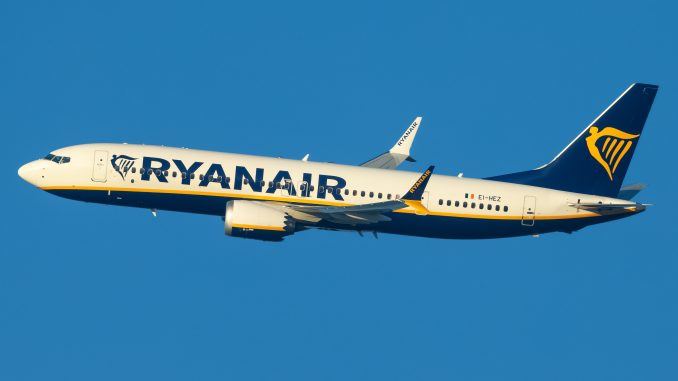
The pilots of a Ryanair Boeing 737 MAX 8‑200 failed to fully complete a checklist during a fuel leak incident and used thrust reversers after landing, increasing the risk of fire, according to a report by the UK’s Air Accidents Investigation Branch.
The incident, which occurred on April 24, 2025, involved EI-HEZ (c/n 62312) operating a scheduled flight from Venice to Manchester. A diversion to London/Stansted was initiated and a safe landing was carried out – none of the 191 passengers or six crew members were injured.
The flight
Reporting for duty at Venice/Marco Polo, the pilots assessed that the weather was good across Europe and agreed to accept the standard operational flight plan (OFP) fuel load, which included 637kg of extra fuel. After an hour’s delay due to a company computer failure, the aircraft was dispatched without any further delay.
Shortly after reaching cruising altitude of FL380, the captain noticed a fuel imbalance developing, with the right main tank indicating 250kg less than the left main tank. The fuel balancing procedure was completed from memory, with the normal fuel pump configuration restored after seven minutes of fuel cross-feeding.
After another 20 minutes of flight, a fuel imbalance of 170kg was noticed with the right main tank low again. The commander decided to action the fuel ‘IMBAL’ (imbalance) non-normal checklist which directed them to the ‘Fuel Leak Engine’ non-normal checklist. The pilots noted an increasing fuel imbalance of around 100kg every ten minutes, which indicated an engine fuel leak. The Boeing Quick Reference Handbook (QRH) states that a change of fuel imbalance of 228kg within 30 minutes or less should be classified as a leak. The cabin crew did not observe any signs of fuel spray from the engine or the strut.
Based on the current leak rate, continuing to Manchester would use all the extra fuel on board (637kg), and so the decision to divert to Stansted was made. The pilots considered that their leak rate of 300kg every 30 minutes was only approximately 70kg above the QRH leak threshold and so decided not the shut down the engine on the affected side given that the weather was good and the diversion was only expected to take 20 minutes. They stopped the checklist and monitored the fuel consumption.
A normal approach was conducted with the IMBAL alert illuminating during the approach, and the aircraft landed with a fuel imbalance of 586kg. The aircraft stopped after exiting the runway and was met by the fire service who confirmed there was fuel leaking from the right engine. The aircraft was towed to stand for passengers to disembark.
Analysis
After reaching cruise, the pilots completed the fuel balancing from memory and missed the prompt at the start of the procedure which reminds crews to consider the possibility of a fuel leak. This, the AAIB said, delayed the start of the diagnosis process until the second imbalance was noticed, some 35 minutes into the cruise.
According to investigators, Boeing encourages the use of the FCOM (Flight Crew Operating Manual) ‘Fuel Balancing’ supplementary procedure with good crew co-ordination to reduce the possibility of errors during a fuel imbalance situation. The procedure can be done from memory by reviewing the steps beforehand or actioning step-by-step as a checklist. The AAIB said that if used in the latter way, it is “likely the pilots would have had the opportunity to diagnose a fuel leak on first recognition of the imbalance at around seven minutes into the cruise”.
When the fuel imbalance was addressed for the second time in flight, the captain actioned the QRH ‘IMBAL’ non-normal checklist although there was no ‘imbal’ alert. A fuel leak was suspected, leading to the QRH ‘Fuel Leak Engine’ non-normal checklist. The pilots confirmed an engine fuel leak, but decided not to continue with the non-normal checklist, which would have led them to shut down the affected engine, because they considered the leak rate to be only marginally greater than the trigger value in the QRH.
The thrust reversers were used for approximately six seconds on landing. With fuel still leaking around the right engine, the use of thrust reverse would have dispersed fuel vapour around the hot parts of the engine, and the risk of a fire would have increased, the AAIB said.
Conclusion
In completing fuel balancing from memory, the pilots did not consider the possibility of a fuel leak, delaying diagnosis of the problem, the AAIB concluded. Once the leak was confirmed, they decided not to fully complete the non-normal checklist, which directed them to shut down the affected engine. The subsequent use of thrust reverse on landing increased the potential risk of fire due to disbursement of fuel vapour around hot parts of the engine.